For Tax Benefit When to Sell and Buy Again Stocks
If you sell stock for more than than yous originally paid for it, then you may take to pay taxes on your profits.
A is any profit from the sale of a stock , and it has unique tax implications. Hither's what you need to know nearly selling stock and the taxes you may take to pay.
Source: The Motley Fool
How to calculate profits from selling stock
When you sell stock, you're responsible for paying taxes simply on the profits -- non on the unabridged sale.
To determine profits, your cost footing (likewise known equally your tax basis), which consists of the amount you paid to buy the stock in the first place, plus any commissions or fees you paid to buy and sell the shares, should be subtracted from your total proceeds.
Cost ground = Cost paid for stock + Commission and fees
Profits = Proceeds from sale-cost basis
Instance of how to summate profits from a stock sale
Let'south say you bought 10 shares of stock in Company X for $10 apiece and paid $five in transaction fees for the purchase. If you later on sold all the stock for $150 total, paying another $v in transaction fees for the sale, here's how you'd calculate your profits:
Cost basis = $100 (x shares @ $10 each) + $10 (purchase and sale fees @ $5 each) = $110
Profits = $150-$110 = $40
So, in this example, you'd pay taxes on the $40 in profits, not the unabridged $150 total sale cost.
Now that you've determined your profits, you tin can calculate the tax yous'll have to pay. The taxes you lot owe depend on your total income for the year and the length of time yous held the shares.
Curt-term and long-term uppercase gains taxes
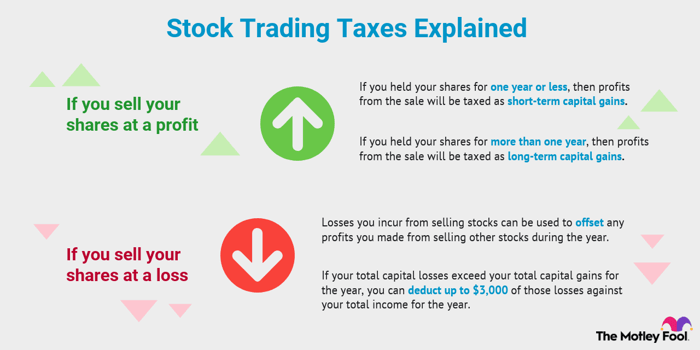
Generally speaking, if y'all held your shares for one year or less, and then profits from the auction will exist taxed as short-term capital gains. If you held your shares for more than than one year earlier selling them, the profits will exist taxed at the lower long-term majuscule gains rate.
Both brusk-term and long-term capital gains revenue enhancement rates are determined by your overall taxable income. Your brusk-term upper-case letter gains are taxed at the same rate as your marginal tax rate (tax bracket). Y'all can get an idea from the IRS of what your tax bracket might for 2021 or 2022.
For the 2021 tax twelvemonth (i.e., the taxes most individuals will file by April 18, 2022), long-term capital letter gains rates are either 0%, xv%, or twenty%. Dissimilar past years, the intermission points for these levels don't correspond exactly to the breaks betwixt tax brackets:
| Long-Term Majuscule Gains Tax Rate | Unmarried Filers (Taxable Income) | Married Filing Jointly/ Qualifying Surviving Spouse | Heads of Household | Married Filing Separately |
|---|---|---|---|---|
| 0% | Up to $40,400 | Up to $fourscore,800 | Upwards to $54,100 | Upwards to $40,400 |
| xv% | $xl,401-$445,850 | $80,801-$501,600 | $54,101-$473,750 | $40,401-$250,800 |
| xx% | Over $445,850 | Over $501,600 | Over $473,750 | Over $250,800 |
Data source: Internal Acquirement Service Revenue Procedure document 2020-45. Figures represent taxable income, not simply taxable upper-case letter gains.
Looking alee to the 2022 tax year (i.due east., the taxes nearly individuals will file by Apr 17, 2023), the three long-term capital gains rates of 0%, fifteen%, and 20% remain the same, but the brackets are adjusted slightly upward for inflation.
| Long-Term Uppercase Gains Tax Rate | Single Filers (Taxable Income) | Married Filing Jointly/ Qualifying Widow(er) | Heads of Household | Married Filing Separately |
|---|---|---|---|---|
| 0% | Up to $41,675 | Upwardly to $83,350 | Up to $55,800 | Up to $41,675 |
| 15% | $41,676-$459,750 | $83,351-$517,200 | $55,801-$488,500 | $41,676-$258,600 |
| 20% | Over $459,750 | Over $517,200 | Over $488,500 | Over $258,600 |
Data source: Internal Revenue Service Revenue Procedure certificate 2021-45. Figures stand for taxable income, non only taxable capital gains.
To calculate your tax liability for selling stock, first decide your profit. If y'all held the stock for less than a year, multiply by your marginal taxation rate. If you held information technology for more than a year, multiply by the upper-case letter gains rate percent in the tabular array higher up.
But what if the profits from your long-term stock sales push your income to a higher bracket? This is sometimes known as the "bump zone." Since capital gains rates are marginal, like ordinary income tax rates, you'd pay the college charge per unit just on the capital gains that caused your income to exceed the threshold. Remember that capital gains are not express but to stock sales; they bear on whatsoever sales of investment assets, including real estate.
Example of long-term capital gains tax
Let's say you and your spouse brand $50,000 of ordinary taxable income in 2022, and you lot sell $100,000 worth of stock that you've held for more a year. Y'all'll pay taxes on your ordinary income first and then pay a 0% upper-case letter gains charge per unit on the commencement $33,350 in gains because that portion of your full income is beneath $83,350. The remaining $66,650 of gains are taxed at the fifteen% revenue enhancement rate.
How to avoid paying taxes when y'all sell stock
One way to avoid paying taxes on stock sales is to sell your shares at a loss. While losing money certainly isn't platonic, losses you incur from selling stocks can be used to get-go any profits you made from selling other stocks during the twelvemonth. And, if your total capital losses exceed your total capital gains for the twelvemonth, yous can deduct equally much as $iii,000 of losses confronting your total income for the year.
I know what you're thinking, and no, you can't sell a bunch of shares at a loss to lower your tax bill and so turn effectually and buy them right dorsum again. The IRS doesn't allow this kind of "launder auction" -- called by this term because the internet effect on your assets is "a wash" -- to reduce your tax liability. If yous repurchase the aforementioned or "substantially similar" stocks inside xxx days of the initial sale, it counts as a "wash sale" and can't be deducted.
Of class, if you end the year in the 0% long-term capital letter gains bracket, you'll owe the government nothing on your stock sales. The only other way to avoid tax liability when you sell stock is to buy stocks in a tax-advantaged account.
Using a tax-advantaged stock account
A revenue enhancement-advantaged account is an investment account such equally a 401(k), 403(b), or traditional IRA. In these accounts, your contributions may be revenue enhancement-deductible, merely your qualified withdrawals will typically count every bit income. Roth accounts, on the other manus, are tax-free investment accounts. You can't become a tax deduction for contributing, but none of your qualified withdrawals will count as taxable income.
With any of these accounts, yous will non exist responsible for paying tax on capital gains -- or on dividends, for that thing -- and so long as yous continue the money in the business relationship. The drawback is that these are retirement accounts, and then you are generally expected to leave your money lonely until you turn 59 1/2 years erstwhile.
Source: https://www.fool.com/investing/how-to-invest/stocks/selling-stock-taxes/
0 Response to "For Tax Benefit When to Sell and Buy Again Stocks"
Post a Comment